AWS Pre-Invent 2025: Top 15 Announcements That Change Everything
AWS pre:Invent 2025 has brought a wave of significant announcements that promise to reshape how we build and manage cloud infrastructure. From predictable pricing models to advanced serverless capabilities, these updates address long-standing pain points for developers and enterprises alike.
Here is an overview of the most impactful launches, ranked by their real-world impact on your architecture, costs, and operational efficiency.
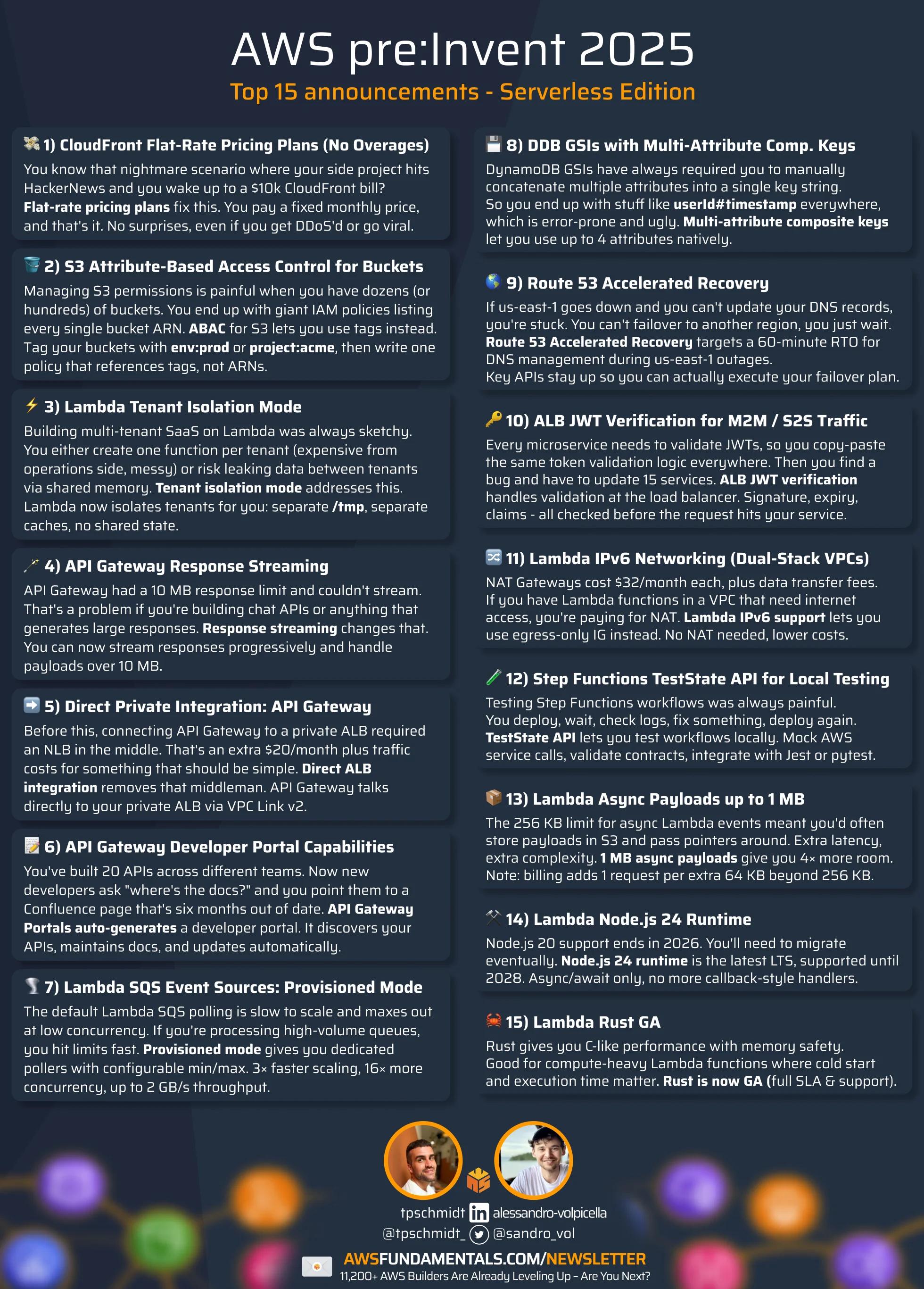
1. CloudFront Flat-Rate Pricing Plans (No Overages)
One of the biggest anxieties for developers using CDNs is the potential for unpredictable costs due to traffic spikes or DDoS attacks. AWS has addressed this head-on with CloudFront Flat-Rate Pricing.
Why it matters
Previously, a viral post or a malicious attack could lead to a shocking bill. With the new flat-rate plans, you pay a fixed monthly fee based on your chosen tier (Free, Pro, Business, Premium).
- Predictability: No more surprise overage charges.
- Security: DDoS traffic doesn't count against your allowance.
- Simplicity: Easier budgeting for projects of all sizes.
This change is a game-changer for startups and enterprises looking to stabilize their AWS costs.
2. S3 Attribute-Based Access Control (ABAC)
Managing S3 permissions at scale has traditionally been complex, often resulting in massive IAM policies that list individual bucket ARNs. S3 ABAC for General Purpose Buckets simplifies this by allowing you to define permissions based on tags.
Key Benefits
- Scalability: Write a single policy that grants access to all buckets with a specific tag (e.g.,
env:prod,project:analytics). - Maintenance: New buckets automatically inherit permissions if they have the correct tags—no policy updates required.
- Security: Reduces the risk of misconfiguration in large environments.
This feature is particularly valuable for organizations managing multi-tenant data lakes or complex Kubernetes environments storing data in S3.
3. Lambda Tenant Isolation Mode
Building multi-tenant SaaS applications on AWS Lambda just got significantly easier and more secure. Tenant Isolation Mode ensures that each tenant's execution environment is strictly isolated.
How it works
- Data Privacy: Each tenant gets a separate execution environment, meaning no shared
/tmpdirectory or in-memory caches between tenants. - Compliance: Satisfies strict data isolation requirements without the need to provision separate functions for each tenant.
- Cost Efficiency: Maintains the benefits of serverless resource pooling while enforcing logical separation.
4. API Gateway Response Streaming
For applications requiring large payloads or real-time data flow, API Gateway's previous 10MB limit was a bottleneck. Response Streaming now allows you to stream data back to the client progressively.
- Use Cases: Perfect for Generative AI applications returning long text responses, or for exporting large datasets.
- Performance: improves perceived latency (Time to First Byte) for end-users.
- Flexibility: Supports payloads much larger than the previous hard limits.
5. Direct Private Integration: API Gateway to ALB
Simplifying network architecture is always a win. The new Direct Private Integration allows API Gateway to connect directly to a private Application Load Balancer (ALB) without needing a Network Load Balancer (NLB) in between.
- Cost Savings: Eliminates the cost of the intermediate NLB (approx. $20/month + data processing fees per link).
- Complexity Reduction: Fewer moving parts means easier troubleshooting and management.
- Security: Keeps traffic within your VPC while exposing it securely via API Gateway.
6. API Gateway Developer Portal Capabilities
Documentation is often the most neglected part of API development. The new Developer Portal capabilities in API Gateway automate the discovery and documentation of your APIs.
- Automation: Automatically discovers APIs and generates documentation.
- Self-Service: Provides a central hub for internal or external developers to find and test your APIs.
- Integration: Works seamlessly with your existing API Gateway configurations.
Quick Fire Round: Other Notable Launches
Beyond the top six, AWS announced several other exciting features:
- Lambda SQS Event Source Mapping Provisioned Mode: Better control over concurrency for SQS-triggered functions.
- DynamoDB GSIs with Multi-Attribute Composite Keys: enhanced query flexibility for complex data patterns.
- Route 53 Accelerated Recovery: Faster failover times for critical applications.
- ALB JWT Verification (M2M/S2S): Offload authentication logic to the load balancer for machine-to-machine communication.
- Lambda IPv6 Networking: Full dual-stack support for Lambda functions.
- Step Functions TestState API: Simplifies local testing of state machine steps.
- Lambda Async Payloads up to 1 MB: increased limit for asynchronous invocations.
- Lambda Node.js 24 Runtime: Support for the latest LTS version of Node.js.
- Lambda Rust GA: Official, fully supported runtime for Rust, offering high performance and low cold starts.
Conclusion
These pre:Invent announcements signal a strong focus on developer experience, cost predictability, and architectural simplicity. Whether you are optimizing a high-scale SaaS platform or managing a growing enterprise cloud footprint, these updates provide immediate value.
For help implementing these new features in your environment, check out our AWS Consulting Services.
Source: AWS Fundamentals
FAQ
When will the new CloudFront flat-rate pricing be available?
These plans are typically rolled out regionally. Check the AWS console for availability in your specific region, but announcements usually imply immediate or imminent availability.
Is there an extra cost for using S3 ABAC?
No, Attribute-Based Access Control (ABAC) uses standard S3 and IAM tagging features, which generally do not incur additional charges for the authorization logic itself.
Can I use the new Lambda Tenant Isolation with existing functions?
Yes, but you will need to configure the isolation mode settings. It is designed to be a configuration change rather than a code rewrite, though you should test thoroughly.
Does the API Gateway to ALB private integration require a specific ALB type?
It requires an internal (private) Application Load Balancer. The key benefit is removing the need for an intermediate Network Load Balancer.